Hotel Guest Experience: 25 Proven Strategies for 2026
By Tom Baker, AHA Hotel Consulting
Hotels improve guest experience by aligning every touchpoint across pre-arrival, in-stay, and post-stay phases, combining frictionless self-service with high-touch service, then measuring results to iterate. Start with mobile-first discovery and booking, remove check-in friction, personalize in-room moments, close the loop on feedback, and tie all of it to asset goals and owner priorities.
AHA Hotel Consulting helps owners move beyond software checklists to an asset-specific strategy that blends operational discipline, revenue authority, and owner alignment. The result is a guest journey where technology removes friction and teams deliver memorable, localized service. This guide shares 25 strategies with data-backed priorities, examples you can deploy now, and a practical roadmap to scale changes at pace while tracking KPIs that matter to valuation and ROI.
Key Takeaways
- Self-service wins attention, not loyalty. 73% of guests are more likely to stay when self-service is offered, but human touch still drives delight GrabScanGo.
- Optimize for mobile now. Mobile drove about 58% of hotel bookings in 2025 and mobile-optimized sites convert 20-30% higher Prostay.
- Measure what matters. The Net Promoter Score (NPS) industry average is about 31, while top luxury hotels exceed 50, a useful benchmark for experience targets Prostay
Defining Guest Experience in 2026 and Its Impact
Guest experience spans every interaction a traveler has with your hotel, from search to rebooking. Personalization sets the tone. 76% of consumers expect it, and 71% feel frustrated when it is missing The Travel Foundry. Autonomy also matters. 73% of guests are more likely to choose properties that offer self-service technology GrabScanGo. Digital fatigue is real. Technology should act as an invisible enabler, not a new interface for guests to manage. Properties that remove transactional friction and reallocate time to human service see stronger reviews and more repeat demand. Owners consistently see measurable gains in RevPAR (Revenue Per Available Room) when measurement and continuous improvement are in place, alongside improvements in reputation.
What do guests expect in 2026?
Three themes stand out. First, personalization that respects context, from room preferences to trip purpose The Travel Foundry. Second, low-friction autonomy that shortens lines and speeds service GrabScanGo. Third, warm, human moments that feel local and memorable. Teams should design for all three, then validate fit through NPS (Net Promoter Score), CSAT (Customer Satisfaction Score), and qualitative feedback. Owners should expect experience investments to compound over time as they lift repeat bookings and lower acquisition costs.
Structuring a High-Impact Guest Experience Strategy
AHA’s approach uses four pillars: Asset-Specific Strategy, Operational Discipline, Technology as an Enabler, and Owner Alignment AHA Hotel Consulting. We map the journey across pre-arrival, in-stay, and post-stay, prioritize friction removal, then stack high-touch moments that reinforce your positioning. Off-the-shelf tools alone do not create this cohesion; disciplined execution and cross-department coordination do. Saved labor hours from automation should be redeployed to high-value interactions that guests remember. For example, redirect front-desk time saved by mobile check-in into curated local itineraries for top segments, or proactive issue resolution through on-shift service leaders.
Aligning Teams and Touchpoints for Consistency
Start with a single view of the guest. Ensure PMS (Property Management System), CRM, and messaging systems share profiles and preferences. Use a weekly journey review to audit bottlenecks and a daily operations huddle to translate insights into action. Standardize a playbook for service recovery and upsell offers by segment. The objective is simple: every department contributes to one promise, expressed consistently across website, lobby, room, outlets, and follow-up AHA Hotel Consulting.
8 Strategies to Optimize the Pre-Arrival Phase
Eight strategies convert intent into booked revenue and prime delight on arrival.
- Mobile-first booking. Mobile accounted for about 58% of hotel reservations in 2025 Prostay. Ensure fast pages, intuitive calendars, wallet payments, and low-friction forms. Sites optimized for mobile convert 20-30% higher Prostay.
- Visual selling. High-quality media and VR can lift website conversion rates by up to 15% WebRezPro.
- OTA (Online Travel Agency) strategy with a direct win-back. OTAs control roughly 55% of booking share; claim visibility, then recapture on your site with member-only perks and mobile UX HospitalityNet.
- Segment-aware offers. AI-driven upsells like romantic packages for couples or expedited check-in for business travelers lift attachment without pushing complexity.
- Expectation setting. Clarify parking, fees, arrival options, and on-property dining in confirmation and pre-arrival sequences to reduce day-one friction.
- Culture-forward content. 54% of travelers prioritize culture over standard tourist attractions. Spotlight hyper-local partners and experiences Oaky.
- Surprise-and-delight. Send a short note 48 hours prior to arrival acknowledging a special occasion and offering a small perk.
- Data capture with value. Collect preferences in pre-arrival forms, and promise usage to personalize in-stay, not to spam.
Pre-arrival conversion checklist
- Test mobile page speed and booking flow on 3 devices Prostay.
- Add short videos or 360 tours on top revenue pages WebRezPro.
- Present two segment-specific upsells after room selection, not before.
- Include clear arrival logistics in the last pre-arrival message.
- Partner with two local businesses per segment to craft weekend itineraries Oaky.
12 Strategies to Elevate the In-Stay Experience
Twelve strategies reduce friction, humanize service, and grow total revenue per stay.
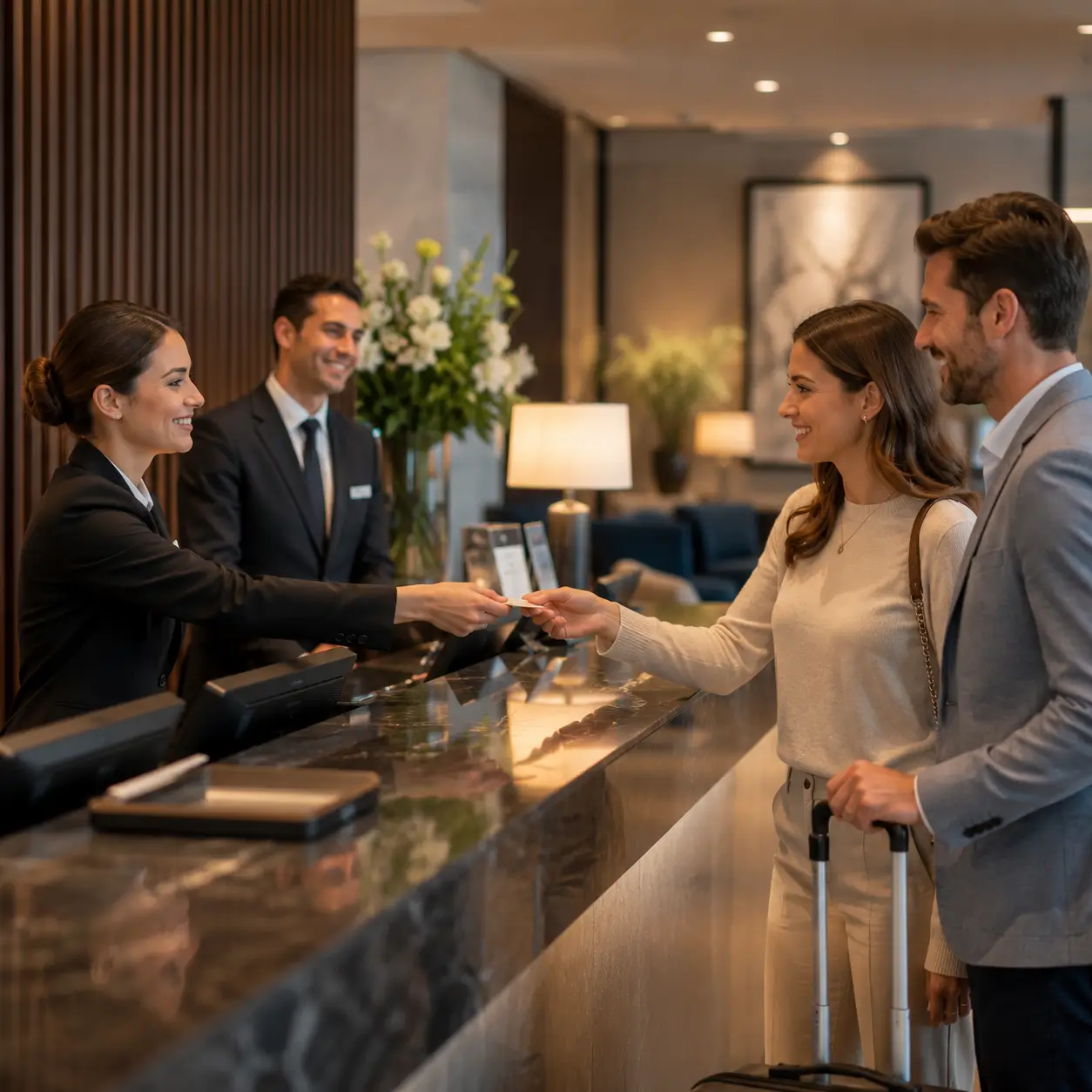
- Frictionless arrival. 73% of guests favor properties with self-service check-in; offer mobile keys or fast-track kiosks GrabScanGo. Mobile check-in via web or app shortens queues and frees staff for welcomes and problem solving Hudini.
- Name recognition. Use daily PMS (Property Management System) reports so every associate addresses VIPs and repeat guests by name.
- Smart room readiness. 86% of hoteliers are offering or planning in-room smart tech; pair this with simple controls and clear how-to cards Blueprint RF.
- Streaming on their terms. 45% of travelers prioritize casting their own accounts to the TV Blueprint RF.
- Omnichannel concierge. Offer SMS or WhatsApp for requests and confirmations so guests do not wait on hold.
- Mid-stay pulse checks. Text a two-question survey on day two to surface hidden issues and fix them before checkout.
- Sustainability choice. 70% of consumers will forego some conveniences for sustainable options. Offer opt-out housekeeping for points or F&B credits WebRezPro.
- Hyper-local programming. Rotate micro-events with neighborhood partners that match guest segments.
- Dynamic offers. Present just-in-time upsells that fit context, such as late checkout after a late F&B check.
- Proactive recovery. Empower leads to comp small items without manager delay when service misfires.
- Queue transparency. Post accurate wait times for dining and services via QR or lobby screens.
- Departure clarity. Offer digital folios by default with easy dispute resolution routes.
Keep tech invisible and service personal
Use technology to eliminate transactions, not interactions. Let guests check in on mobile, then invest saved minutes in a proper arrival greeting Hudini. Keep in-room tech simple and guest-led. Casting options meet nearly half of traveler preferences, so highlight them at check-in and in-room cards Blueprint RF. Close the loop fast when the pulse survey flags an issue, and follow up in person to confirm the fix.
5 Strategies to Build Loyalty After Checkout
Five strategies extend the stay into advocacy and repeat demand.
- Timed, segmented follow-up. Send a thank-you within 24 to 48 hours with content tailored by segment and trip type.
- Ask better, not more. A short survey, plus one open-ended question, yields the insight you need to drive change.
- Experiential loyalty. 78% of Millennials prefer spending on experiences over things. Trade points-only rewards for private tours or behind-the-scenes culinary access The Travel Foundry.
- Social proof engine. User-generated content increases brand trust by a factor of 2.4. Curate guest photos and stories with permissions and credit MarketingLTB.
- Smart rebooking. Use stay data and anniversary dates to craft offers that feel personal rather than generic blasts.
Design loyalty for experiences, not just discounts
Move beyond generic tiers. Create a menu of local experiences that align to key segments, then invite recent guests to choose their reward. Many guests are comfortable sharing data when they see value, with 90% willing to share for better experiences MarketingLTB. Close the loop by showcasing guest stories in newsletters to reinforce the benefits of returning.
Essential Technology and Training for Guest Experience
Select tools that remove friction and surface insight. Prioritize PMS (Property Management System), CRM, messaging, and payments that share data cleanly. Over-automation can feel sterile; the goal is to free people to deliver hospitality, not to replace them AHA Hotel Consulting. Use mobile check-in to save minutes, then reassign time to concierge-level conversations for top segments Hudini. Training must keep pace. Front-line teams need emotional intelligence, active listening, and fast problem-solving. Give them clear empowerment limits and simple playbooks for recovery and upsell moments.
Build a human-centric tech stack
- Remove password friction with secure links for mobile check-in Hudini.
- Standardize SMS templates for confirmations and updates while allowing personal tone.
- Coach agents to spot emotion in messages and switch to a call for sensitive issues Heymarket.
- Run monthly refreshers on service recovery and experiential upsells AHA Hotel Consulting.
Measuring Guest Experience Performance Effectively
Measure relentlessly, then iterate. Track NPS (Net Promoter Score), CSAT (Customer Satisfaction Score), repeat guest percentage, complaint themes, and resolution speed. The NPS industry average is about 31, while top luxury hotels exceed 50, a practical bar for high-touch brands Prostay. Pair numbers with qualitative insights from open-ended responses and reviews to find root causes and wins. Close the loop with an owner-aligned cadence. Weekly ops reviews fix near-term issues. Monthly cross-functional reviews reallocate resources and refine offers. Continuous improvement, paired with a clear benchmark, sustains gains.
Build a simple experience dashboard
- NPS by segment with verbatim themes attached Prostay.
- Complaint resolution time with a target of same-day for in-stay issues.
- Upsell attachment by segment and channel to guide next best offers.
- Website mobile conversion rate to validate pre-arrival improvements.
A Practical 90-Day Guest Experience Implementation Plan
Start with a focused roadmap that respects capital plans and owner priorities. Days 1-30: Audit the journey, reduce friction. Map the guest path, fix top three digital blockers on mobile booking, deploy clear pre-arrival comms, and pilot mobile check-in for one segment Prostay Hudini. Days 31-60: Humanize in-stay. Train teams on name use from daily PMS (Property Management System) reports, launch mid-stay pulse surveys, and offer opt-out housekeeping with a clear sustainability message WebRezPro. Days 61-90: Systematize loyalty. Launch segmented post-stay messages, introduce two experiential rewards, and build a KPI dashboard tied to owner goals MarketingLTB Prostay.
Common pitfalls and how AHA helps avoid them
- Fragmented tools with no shared profiles. AHA aligns PMS (Property Management System), CRM, and messaging so teams act on one view AHA Hotel Consulting.
- Automating the welcome. We help redeploy saved labor to high-value moments, not more screens.
- Chasing points over experiences. We design experiential loyalty that aligns to your segments and local brand story The Travel Foundry.
- Skipping measurement. We operationalize NPS (Net Promoter Score) and close-the-loop reviews so improvements stick Duve. In one AHA engagement, The Modernist Hotel achieved an 11% year-over-year RevPAR (Revenue Per Available Room) increase through revenue recalibration, operational margin engineering, and an experience-led service culture. This result illustrates how structured execution can turn strategy into financial outcomes.
Frequently Asked Questions (FAQ)
What do hotel guests expect in 2026?
Hotel guests in 2026 expect three things: personalization that respects their context (such as room preferences and trip purpose), low-friction autonomy that makes service faster and more convenient, and warm, local human moments. Meeting these expectations requires hotels to blend technology-enabled convenience with memorable, people-driven service, and to validate success through metrics like NPS (Net Promoter Score), CSAT (Customer Satisfaction Score), and guest feedback.
How can hotels measure guest experience?
Hotels should measure guest experience using a combination of quantitative and qualitative metrics. Key metrics include NPS (Net Promoter Score), CSAT (Customer Satisfaction Score), repeat guest percentage, complaint themes, and resolution speed. Pairing these numbers with insights from open-ended survey responses and guest reviews helps hotels identify both root causes of issues and areas of success.
What is a good NPS score for a hotel?
A good NPS (Net Promoter Score) for a hotel is above the industry average of 31. Top-performing luxury hotels often exceed 50, which sets a practical benchmark for brands aiming to deliver high-touch, memorable experiences.
What does RevPAR mean and why is it important?
RevPAR stands for Revenue Per Available Room. It is a key performance indicator that measures a hotel’s ability to generate revenue relative to its available rooms. Improving guest experience has a direct impact on RevPAR by increasing repeat bookings and positive reputation, which ultimately drives higher occupancy and rates.
Conclusion
Hotel guest experience is a system, not a set of tactics. The data supports a clear path: make booking mobile and visual, give guests autonomy where they want it, invest saved minutes into high-touch service, and measure relentlessly against owner-aligned targets. Personalization at scale, coupled with choice and local character, earns advocacy and repeat bookings. If you want an asset-specific plan that your team can execute in 90 days, AHA Hotel Consulting can help. We align technology with operations, train teams for human moments, and install a measurement cadence that protects ROI. Contact us to audit your journey, prioritize high-ROI fixes, and build a repeatable playbook that compounds value.
References
- Guest Experience Strategies
- Why Self-Checkout is Important in a Hotel Lobby Market
- Key Hotel Performance Metrics
- Hospitality by the Numbers: 40 Stats You Should Know
- Guest Experience: Trends and Strategies
- Hotel Customer Journey: The Guest Experience Guide
- Hotel Room Technology Trends
- 6 Reasons Why Your Hotel Needs Mobile Check-ins
- Customer Experience Statistics
- How to Measure and Improve Guest Experience
- AHA Hotel Consulting Services
The AHA Takeaway
At AHA Hotel Consulting client satisfaction is a critical component to our success. Building strong relationships and producing positive results are core principles for our business. The owners of the Modernist Hotel recently shared a positive review on the AHA online business listing that reflects the importance of building these core principles.
Let’s talk about your vision. Use the quick form below and I’ll personally reach out.
– Tom Baker, Managing Principal