
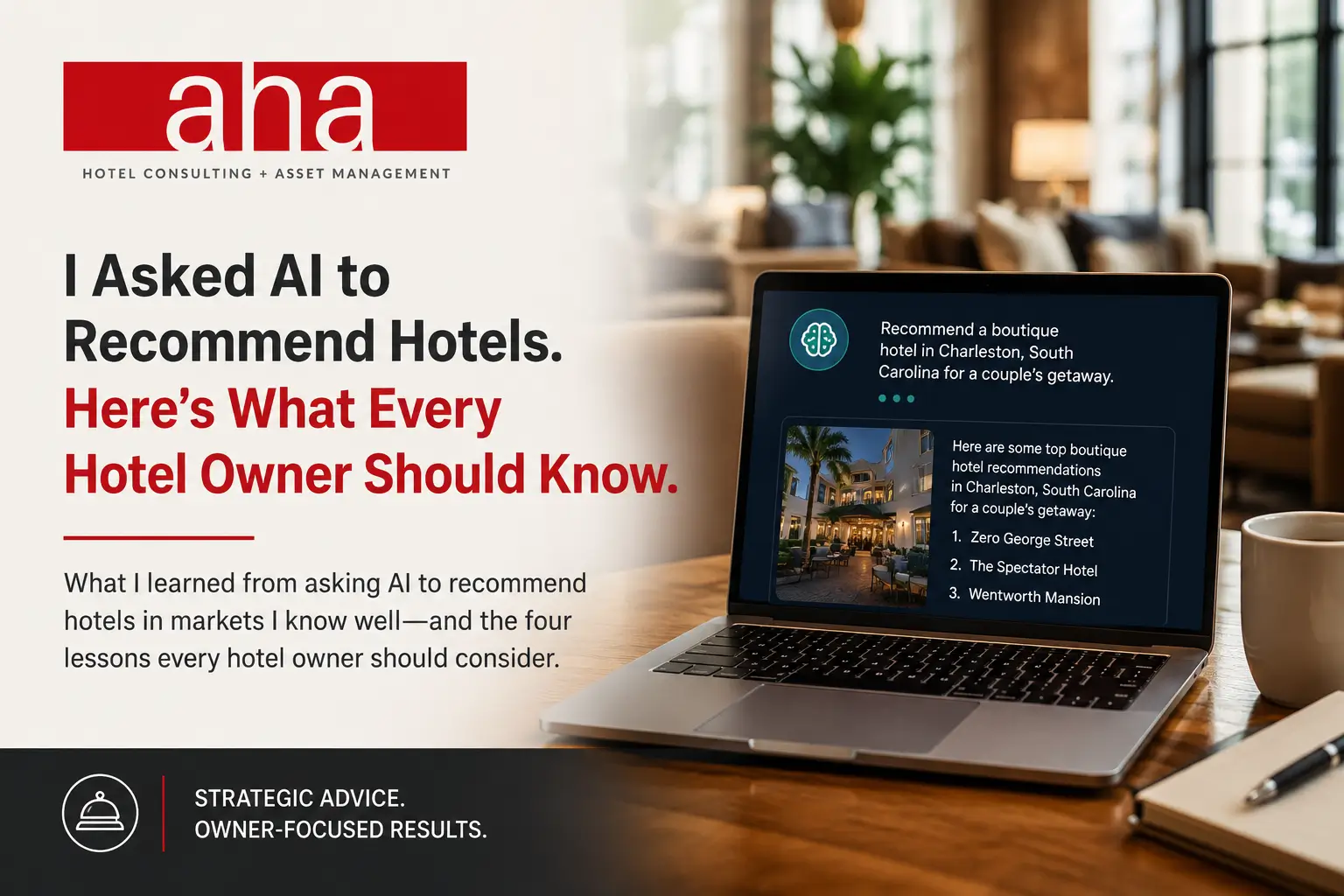
Here’s What Every Hotel Owner Should Know.
By Tom Baker, AHA Hotel Consulting
During my thirty years in the hotel industry, I’ve watched travelers move from travel agents to online travel agencies, hotel websites, mobile booking, and eventually Google’s dominance in search. Each shift changed how hotels attracted guests, but the booking process remained largely the same. Travelers gathered information, compared alternatives, and made their own decisions.
Artificial intelligence is beginning to change that process.
Rather than reviewing pages of search results, travelers are increasingly asking AI platforms such as ChatGPT and Gemini to recommend hotels based on the experience they want to have. Curious about how these recommendations were being made, I spent several weeks asking AI to recommend hotels in destinations where I’ve managed properties, competed against other hotels, or advised ownership groups.
What I found surprised me.
Luxury resorts in markets like Sedona were generally recommended exactly as I would have expected. However, when I repeated the exercise in several markets with outstanding independent hotels, the results became far less consistent. Some exceptional properties appeared regularly, while others with equally strong reputations were rarely mentioned.
After reviewing those hotels more closely, I realized the issue usually wasn’t the quality of the operation. More often, it was the quality of the story being told online.
Many hotel websites still function as digital brochures. They describe guestrooms, amenities, and meeting space in detail but devote very little attention to explaining what actually makes the property memorable. For years that approach was adequate because travelers performed most of the research themselves. AI is beginning to compress that process by recommending a much smaller group of hotels before a traveler ever visits a website.
That observation reminded me of something I’ve seen throughout my career. Owners often believe they have a marketing problem when they really have a positioning problem. If a hotel can’t clearly communicate why someone should choose it over competing properties, no amount of advertising will permanently solve the issue. Artificial intelligence hasn’t created that challenge, but it has exposed it in a way I believe every owner should pay attention to.
This isn’t a reason to abandon traditional marketing or become consumed with the latest technology. Search engine optimization, online reviews, photography, and direct bookings
remain just as important as they’ve always been. What’s changing is how travelers evaluate hotels before they ever reach your website.
After spending time experimenting with AI, I came away with four conclusions that I believe every hotel owner should consider.
1. Explain Why Someone Should Stay at Your Hotel
Most hotel websites do an excellent job describing the physical property. They explain room categories, meeting facilities, restaurants, pools, and fitness centers. Unfortunately, those are rarely the reasons guests choose one hotel over another. Travelers don’t simply want to know what your hotel offers—they want to know what it feels like to stay there. A first-time visitor should immediately understand who your hotel is designed for, what makes it different from the competition, and why previous guests continue to return. Owners should spend less time describing their buildings and more time describing the experience those buildings create. That’s what guests ultimately purchase, and it’s the type of information AI appears to value when making recommendations.
2. Become the Best Source of Information About Your Destination
Think about the conversations your front desk team has every day. Guests ask where to eat, what to see, how to spend a free afternoon, which attractions are worth visiting, and what locals recommend. Those same questions are increasingly being asked of AI before travelers ever book a room. Hotels that consistently publish thoughtful, original content about their destination aren’t simply improving their marketing—they’re establishing credibility. Restaurant recommendations, weekend itineraries, seasonal events, hidden attractions, and local experiences all reinforce your property’s connection to the destination while providing valuable information that travelers are actively searching for. In my opinion, that combination of expertise and authenticity will become an increasingly important competitive advantage.
3. Evaluate Your Hotel the Way a Traveler Would
One of the simplest exercises I would recommend is asking AI to recommend hotels in your own market without mentioning your property’s name. Describe your ideal guest and the type of experience they’re looking for, then review the recommendations objectively. If your hotel appears, pay close attention to how it’s described and whether the recommendation accurately reflects the experience you’re trying to deliver. If your hotel doesn’t appear, resist the temptation to assume the technology is flawed.
Instead, consider whether your website, photography, online reviews, and overall messaging clearly communicate why someone should choose your property. I suspect many owners will discover opportunities that traditional marketing reports never reveal.
4. Never Forget That Great Hotels Have Always Told Great Stories
The biggest lesson I took away from this experiment had very little to do with artificial intelligence. Throughout my career, the hotels that consistently outperformed their competitors almost always had something in common. They knew exactly who they were, understood the guests they wanted to attract, and delivered an experience that matched the promises made in their marketing. Technology has changed dramatically over the years, but that principle hasn’t. Artificial intelligence doesn’t create great hotels, and it won’t rescue mediocre ones. What it appears to do is reward properties that communicate their identity clearly and consistently. When I began experimenting with AI, I expected to learn more about technology. Instead, I found myself being reminded of something this industry has taught me repeatedly over the past three decades. Hotels succeed when they know who they are, understand who they’re trying to serve, and consistently deliver on that promise. I believe that was true before Google became the dominant search engine, it’s true today, and it will remain true long after artificial intelligence becomes a normal part of how travelers plan their next trip.
Editor’s Note: This is the first in a series examining how artificial intelligence is changing hotel ownership, operations, marketing, and guest acquisition.
The AHA Takeaway
At AHA Hotel Consulting client satisfaction is a critical component to our success. Building strong relationships and producing positive results are core principles for our business. The owners of the Modernist Hotel recently shared a positive review on the AHA online business listing that reflects the importance of building these core principles.
Let’s talk about your vision. Use the quick form below and I’ll personally reach out.
– Tom Baker, Managing Principal